Friday, 20 January 2012

Richard Deacon

Richard Deacon "CBE" was born in Bangor (August 15, 1949) and preferred to be known as a fabricator rather than a sculptor.  His work is abstract and often constructed from everyday materials such as laminated plywood, galvanised steel, aluminium, vinyl and copper.  Some of his larger pieces were created for specific events or sculpture gardens.

Deacon's latest work will be a permanent installation, a sculpture, suspended and on a scale never accomplished before.  This will take place in Singapore.
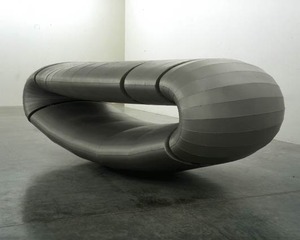
Nothing is Allowed, 1994, stainless steel

"There is for me another sense to the title.  Fluctation of light on the surface changes according to the time of day and as a spectator moves past.  The experience is grounded in a moment in time that is fleeting but a part of an infinite sequence." ~ Richard Deacon, speaking about his work, "Infinity".

Richard Deacon is the final artist of this journey but not the only sculptor to have been influenced by past sculptors and to be a great influence on sculptors to come.

Donald Judd


Donald Judd (June 3, 1928 - February 12, 1994) was an American born minimalist painter, but during the 50s he began to create 3d works and stopped painting. During the beginning of the 1980s, critics began to perceive Judd's work as repetitive, but not long after, he discovered enamelling, which gave his work better colour and made his work more dynamic.

Materials that Judd used include concrete, brass, copper, aluminium, plywood, granite, plexiglas and stainless steel.  In the 80s he began to use "Cor-ten" steel, something which he had previously avoided because of Serra's frequent use of the material.
The majority of his work seems to be "boxes" with plenty of bright colours and crisp, clean edges.


Concrete Constructions, Built in 1980 to 1984 (Marfa, Texas)

"Too often, I believe, the meaning of a work of art is lost as a
result of a thoughtless or unsuitable placement of the work for display. The installation of my own work, for example, as well as that of others, is contemporary with its creation, and the space surrounding the work is crucial to it. Frequently as much thought has gone into the placement of a piece as into the piece itself." ~Donald Judd

Wednesday, 18 January 2012

Anthony Caro

Sir Anthony Caro was born in 1924 and is still going strong as an artist and his newest works are still in keeping with his easily recognisable abstract style.  While studying sculpture at the Royal Academy he worked Henry Moore's assistant.   He taught at St Martin’s School of Art in London from 1953 to 1981, where he was very influential.

Caro uses a wide range of materials, including steel, bronze, silver, lead, stoneware, wood and paper.  He was a sculptor who had a huge impact on 20th century sculpture and changed the future of 3d art.

Fossil Flats 1974, Steel, rusted & varnished (www.anthonycaro.org)

Caro has said that Henry Moore was a father figure and David Smith was a competitor in his early days.
    
"Sculpture is like cubism" ~ Anthony Caro

Tuesday, 10 January 2012

Richard Serra

In 1966, Serra made his first sculptures out of nontraditional materials such as fiberglass and rubber. Serra's earliest work was abstract and process-based made from molten lead hurled in large splashes against the wall of a studio or exhibition space. Still, he is better known for his minimalist constructions from large rolls and sheets of metal.

Richard Serra's work, from small sculpture to his huge public sculptures made of lead or steel, comes across so raw, yet it contains Serra himself. Serra is an American minimalist sculptor and video artist and was also involved in the Process Art Movement.

The shades of colour of the works change as the weathering steel undergoes a gradual oxidization process. The relationship between sculpture and the human body is explored through scale, equilibrium, weight, and tension. - Guggenheim Bilbao

Splashing, 1968, lead

"What I wanted was a dialect between one's perception of the place in totality and one's relation to the field as walked." Richard Serra (November 2, 1939) speaking about 'Shift' (1970 - 1972) 

The concept of changing perspectives of the landscape is intriguing and appeals to me personally. 

Friday, 6 January 2012

David Smith

David Smith (March 9, 1906 - May 23, 1965) is known as the "Father" of American sculpture.  He was an abstract expressionist sculptor and painter.  

David Smith was awarded the Guggenheim Fellowship in 1950, which was renewed the following year.   As it paid out a lot of money, he made more and larger pieces and for the first time was able to afford to make whole sculptures in stainless steel.  He also began his practice of making sculptures in series, the first of which were the Agricolas of 1951-59.
Six of his sculptures were included in an exhibition organized by the Museum of Modern Art, New York, that travelled to Paris, Zurich, Düsseldorf, Stockholm, Helsinki and Oslo in 1953-54.  He was given a retrospective exhibition by MoMA in 1957.

Sentinel I, 1956, welded steel

"What it can do in arriving at a form economically, no other medium can do.  What associations it possesses are those of this century: power, structure, movement, progress, suspension, brutality." ~ David Smith
Metropolitan Museum of Art

Barbara Hepworth

Barbara Hepworth DBE (10 January 1903 – 20 May 1975) was an English modernist-abstract sculptor. She helped to develop modern art (sculpture in particular) in Britain along with contemporaries such as Gabo, Moore and Nicholson.


A new £35 million museum dedicated to Hepworth, the Hepworth Wakefield, opened in Britain in May 2011 at Wakefield in West Yorkshire.

The artist sometimes combined organic form with natural materials and the use of string. The Russian Constructivist sculptor, Naum Gabo used nylon thread in his sculpture from around 1938 and Hepworth, who knew him well, may have been influenced by this, as well as by mathematical models. The string emphasizes the tension between the interior and exterior of the work. This tension is further highlighted by the contrast between the polished wood and matt, painted interior (National Gallery, Scotland).


Pelagos, 1946

Pelagos ('sea' in Greek) was inspired by a view of the bay at St Ives in Cornwall, where two arms of land enfold the sea on either side. The hollowed-out wood has a spiral formation resembling a shell, a wave or the roll of a hill. Hepworth wanted the taut strings to express 'the tension I felt between myself and the sea, the wind or the hills'. She moved to Cornwall with her husband Ben Nicholson in 1939, and produced some of her finest sculpture in its wild landscape.

Personally I am greatly influenced by the ideas of Hepworth's and Gabo's. As I design my work and write down my ideas, I try to go through the same processes. Natural materials, tension, mathematical and architectural models and the different ways to view the sculpture are some things I consider when thinking of ideas.

Friday, 9 December 2011

Henry Moore

Henry Spencer Moore "Companion of Honour", "Fellow of the British Academy" (30 July 1898 - 31 August 1986) was an English sculptor and artist. He was best known for his semi-abstract monumental bronze sculptures which are located around the world as public works of art.

His forms are usually abstractions of the human figure, typically depicting mother-and-child or reclining figures. Moore's works are usually suggestive of the female body, apart from a phase in the 1950s when he sculpted family groups. His forms are generally pierced or contain hollow spaces. Many interpreters liken the undulating form of his reclining figures to the landscape and hills of his birthplace Yorkshire.

Moore was born in Castleford, the son of a coal miner. He became well-known through his carved marble and larger-scale abstract cast bronze sculptures, and was instrumental in introducing a particular form of Modernism to the United Kingdom. His ability in later life to fulfill large-scale commissions made him exceptionally wealthy.

File:HenryMoore RecliningFigure 1951.jpg
Reclining Figure, fibreglass cast, 1938

"The observation of nature is part of an artist's life, it enlarges his form [and] knowledge, keeps him fresh and from working only by formula, and feeds inspiration." ~ Henry Moore